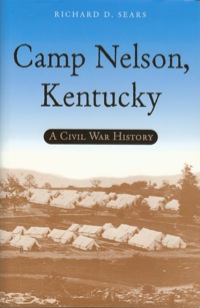
Camp Nelson, Kentucky: A
Civil War History
by Richard Sears
512 pages, published 2002
ISBN: 0-8131-2246-5
Price $45.00 (hardcover only)
For a .pdf of this article, click here.
For more on Camp Nelson, click here.
THE STORY

A
tired, thirty-nine-year-old Hoosier general, looking well
beyond his years, arrived at his new Cincinnati
headquarters in the spring of 1863. It had been a long time
since anything much had gone right for him, and the fact
that he was still in uniform was a small miracle. In less
than two years, General Ambrose Everett Burnside had
accumulated an army career with more unpredictable twists
than any other Union high commander except, perhaps,
General George McClellan. After some early war successes in
North Carolina, and twice refusing command of the Army of
the Potomac, President Lincoln essentially forced Burnside
to take control of the largest army in North America in a
desperate attempt to find a general capable of defeating
Robert E. Lee. However, Burnside’s ill-conceived
charge up Marye’s Heights at Fredericksburg in
December 1862 proved that he lacked the creativity required
to meet the challenge.
To accomplish this, Burnside needed a secure base where he could collect his men before the Tennessee invasion and from which he could provision them after his troops were in the field. By May, General Burnside was accumulating supplies at a “depot near Hickman Bridge.” His base of operations in central Kentucky, named after the late Major General William “Bull” Nelson, would become one of the most storied Union camps in Civil War history.
By summer, Camp Nelson had evolved into a major recruitment and supply hub. Dozens of buildings popped up, and soon a medium-sized city had sprouted from the land between Hickman Creek and the Kentucky River. Barracks, hospitals, bakeries, a prison, water stations, quartermasters' warehouses, blacksmith shops, officers' quarters, roads, and fortifications were erected with the help of local slave labor. The countryside was scoured for food, mules, and horses as the camp became a well-known focal point in the central Bluegrass region of Kentucky. Although perfect in terms of defensive topography, the lack of a good, all-weather road connecting the camp to East Tennessee would make it a mixed blessing at best.
In August 1863, General Burnside took the 9th and 23rd Army Corps out of Camp Nelson toward eastern Tennessee. Shortly thereafter, the camp assumed its next operational phase. Not only would Nelson be a logistics base for Burnside’s invasion, but refugees, recruits, and wounded soldiers from the East Tennessee war zone would funnel the 200 miles north to the safe harbor of the central Kentucky fort.
While exhausted Tennessee refugees struggled to stay alive on the way to Camp Nelson, no less an authority than Union General Ulysses S. Grant personally confirmed that the cruel winter season had rendered roads between Nelson and East Tennessee impassible. Thus, Camp Nelson failed to achieve its primary objective. Burnside’s army in Tennessee, devoid of horses and food, and, cut off from the millions of rations in Camp Nelson’s warehouses, would have to fend for itself. His men would have to subsist on a barren countryside with occasional supplement from Chattanooga.
In the spring of 1864, the future of Camp Nelson was at a turning point. With the eventual success of Burnside’s East Tennessee campaign, and Union battle lines as far south as Georgia, both Generals Grant and Sherman questioned the wisdom of keeping a sizable depot in central Kentucky. As the Union high command considered winding down activities at Nelson, the camp’s most significant chapter was dawning. Black men began arriving at the camp to claim freedom by becoming Union army soldiers. This event is perhaps the most noteworthy milestone in Kentucky race relations. Although colored soldiers from other states had been part of the Union army for some time, Kentucky had managed to quietly dodge the issue. The near apoplectic reaction on the part of Kentucky officers and politicians throughout the state was telltale. The episodes that followed stand as the most chilling in the camp’s history. The barbaric treatment of African-American families, and their endless hurdles to a hopeful future, are never illustrated with more alarming clarity than by what happened at Camp Nelson in 1864-66.
THE BOOK
Camp
Nelson, by Richard Sears, is arranged in an
unfamiliar manner. The book is divided into two sections
– a 60-page narrative Historical Introduction (with
copious footnotes), followed by almost 400 pages of
chronologically arranged letters, official communications,
telegrams, and reports dealing with every imaginable aspect
of camp history. Some assembly is required. Whereby the
lengthy Introduction may be enough to build an adequate
understanding of the camp’s military and social
impact, the author follows up by revealing every brick and
beam in the story’s construction. Because these
documents arrive like a shower from a never-ending cast of
characters (with their varying styles, ranks, points of
view, and educational levels), it requires some
concentration to coagulate the mass.
However,
the longer you spend with the book, the more you appreciate
the author’s method. To me, Camp Nelson’s
association with the Union army's recruitment of Kentucky's
African-American slaves is its most important legacy. This
portion of the story remains amply powerful by simply
pulling the curtain off the sources. I was riveted
icy-still by the horrific November 1864 reports detailing
the expulsion from camp of all family members of Union
colored soldiers while the soldiers themselves were off
fighting in the field. Hundreds of women and children -
hungry, penniless, and without other destinations - were
summarily ejected into the frosty winter night.
Congregating on roadsides, fields, and nearby towns, many
froze to death while telegrams debated the legal status of
colored family members of Union soldiers. But from the
black shadows of human behavior came a redeeming glimmer of
luminosity. Reverend John G. Fee of the United States
Christian Commission corresponded with blunt truth about
Kentucky slavery and acted as a tireless advocate of
equality for all God’s “humble trusting
millions.” Fee was instrumental in urging shelter and
schools for these disenfranchised families, making Camp
Nelson the most important destination for Kentucky
African-Americans during the collapse of slavery in the
state.
Sears’
Camp Nelson is the first comprehensive work on the
subject; it is likely to remain the foundation for many
others. His scrupulous attention to detail and obvious
commitment to the subject are awe-inspiring. It is rich
with source materials that will fuel researchers for many
years to come. In our impatient culture, it should be noted
that this book requires a bit more attentiveness than we
may be used to in our reading, but yields well more
results.
Richard D. Sears is Chair of the Department of English and
Theatre at Berea College, Kentucky.
◊◊◊◊◊
Following is a short
e-interview with the author of Camp
Nelson, Kentucky: A Civil War
History, conducted January 30,
2006:
RM:
Reverend John G. Fee was a man way ahead of his time and a
kind of connecting thread in your work. How did you come
upon Mr. Fee and what was it about him that captured you?
Dr.
Sears: I came to know of John G. Fee because I teach
at Berea College (which he founded), and I live in Berea,
Kentucky (which he also founded). As I have learned about
Fee's work as an abolitionist and social reformer, my
admiration and respect for him have grown. He was
years ahead of his time, both in his principles and in his
actions; he believed in social equality among the races,
for example, but he also took drastic steps to put that
belief into practice. That was the consistent pattern of
his life.
RM: Camp Nelson is
undergoing something of a revival recently. What do you
think is the most important legacy Camp Nelson has for us
today?
Dr.
Sears: The most important legacy Camp Nelson has for
us today is its history during and immediately after the
Civil War, when it was virtually a paradigm of the
hardships and opportunities that African-Americans had as
our social and political system experienced its (arguably)
most significant revolution. The transition from slavery to
freedom is remarkably well illustrated by the events at
Camp Nelson. Now that the geographical Camp has become an
interesting sort of theme park with a restored building and
a proposed museum, the site offers many educational
opportunities for visitors exploring the Civil War in
Kentucky and the African-American experience.
RM: Camp Nelson, Kentucky, is
a wonderful example of careful scholarship shaped by an
abiding passion for the subject. When did you decide you
needed to write this book, how long did it take, and what
unusual obstacles did you face?
Dr.
Sears: I decided to write my book about Camp Nelson
many years ago. Altogether I spent more than a decade on
it, with years of research, then writing and rewriting. I
guess the most persistent obstacle throughout the process
of working on this book was a very simple matter:
deciphering the handwriting of hundreds of different
people, many of them quite ill-educated, some in a dreadful
hurry, some (like John G. Fee) who always wrote in hen
scratches.
My thanks to
Dr. Richard D. Sears, author of Camp Nelson,
Kentucky: A Civil War History.
Go hereto purchase his
book.
